Separating Popular Music and Political Activism from the Warencharakter
'I believe, in fact, that attempts to bring political protest together with ‘popular music’ – that is, with entertainment music – are for the following reason doomed from the start. The entire sphere of popular music, even there where it dresses itself up in modernist guise is to such a degree inseparable from the Warencharakter (1) from consumption, from the cross-eyed transfixion with amusement, that attempt to outfit it with a new function remain superficial And I have to say that when somebody sets himself up, and for whatever reason (accompanies) maudlin music by singing something or other about Vietnam being unbearable…I find, in fact, THIS SONG unbearable, in that by taking the horrendous and making it somehow consumable, it ends up wringing something like consumption-qualities out of it.’ A transcript of an interview ‘Adorno about popular music’
In this interview, Adorno is referring to a Joan Baez performance of ‘oh, freedom’. The interview must have been recorded between 1967 and 1969, given the nature of the footage and also due to the fact Adorno died in 1969. Joan Baez, an American recording artist, had been using her music as a form of political protest in the fields of human rights, peace and environmental justice since 1963 when She sang ‘We shall overcome’ at the March on Washington for jobs and freedom.
This is not an argument that Joan Baez is the best example of popular music and political protest coming together, quite clearly looking through her back catalogue although a songwriter she is more known for being an interpreter of other people’s music. She has however throughout her career remained true to her belief in non-violence and as such has used her music to promote this by connecting with both the subject in the real world and also with her audience. Instead the essay aims to prove that bringing together political protest and popular music creates authentic culture, which in turn promotes active listening and opens up its meaning and significance thus separating itself from the ‘warencharakter’. This argument will be supported by an analysis of certain Album Covers and how their ‘paratextual’ qualities contribute to this authentic culture.
Adorno qualified his assertion that popular music and political protest are doomed ‘even when it dresses itself in Modernist guise’; meaning even when the intention is to improve people’s lives. This suggests he may have been aware of Baez’s dedication to social justice to this point. She had been vocal about her disagreement with the Vietnam War since 1964 when she publicly endorsed resisting taxes by withholding sixty per cent of her 1963 income taxes. In 1967, she was arrested and imprisoned for ten days for taking part in a sit-in at a military induction centre. In 1972, she attended a peace delegation travelling to North Vietnam and was caught in the eleven-day bombings of Hanoi. (The Guardian 2009 and BBC news archives)
There is strong evidence to demonstrate that her motives for singing in the context of the Vietnam War were in fact to raise awareness and promote action against the horrendous nature of the Vietnam War and not to sell more ‘entertainment records’. On the whole her album artwork has not been expressive of her political activism apart from 'Blessed are' (Vanguard, 1971) and ‘Come from the shadows' (A& M Records 1972). The black and white cover photograph of Come from the shadows (Figure one) documents an elderly couple being arrested at an anti-war protest, holding hands and flashing peace signs as they are led away. This signifies that the protest is not just part of a sub-cultural movement but is supported by middle class America too. These two serious, diminutive rain soaked figures provide a rousing juxtaposition in front of the much taller, stronger, helmeted arresting Officers. The young man in support in the background proudly displays his CND badge and strides almost triumphantly to his arrest. Joan Baez quoted from the back of the Album cover (figure two): “.... In 1972 if you don't fight against a rotten thing you become a part of it. What I'm asking you to do is take some risks”. ….... “in short, sisters and brothers, arm up with love and come from the shadows " –(Come from the shadows, Joan Baez A&M records 1972)
The Album Cover does not seek to promote itself, being deliberately low key and completely black and white. The title and artist name are set in a small point size typewriter style font, which would have been commonplace at this time. In Coverscaping ,the authors suggest an album cover, ‘simultaneously embodies commercial, indexical, ekphrastic, narrative and paratextual qualities’ (2010, p11) They use paratextual as Genette’s literary notion ‘ a zone not only of transition but also transaction’ (p10). The ‘Come from the shadows’ cover uses paratextual and ekphrastic qualities, particularly in a historical context, over and above a commercial function. This Album cover analysis and also the contextualizing of Joan Baez’s life provides a strong case that her primary objective has been to raise awareness and promote change, in other words contribute to the creation of ‘Authentic Culture’. Authentic’ Culture is defined by Horkeimer, a fellow theorist of Adorno from the Frankfurt School. John Storey explains Horkeimer’s Authentic Culture ‘as a function… to keep alive human desire for a better world beyond the confines of the present.’ (2001, p86) Also contrary to Adorno’s own ideas that popular music promotes ‘passive listening’ and acts as ‘social cement’; by raising political and social issues in popular music, musicians create a ‘desire to change the status quo’ in their audiences. The Clash, a pioneering Punk band formed in the Summer of 1976, are credited with advocating radical politics in their music. Joe Strummer, the front man and rhythm guitarist, explained how the Notting Hill Carnival riots influenced them ‘We were there at the throw of the very first brick…. This was one time where people went we’ve had enough. This was what gave rise to the song ‘white riot’ because we participated in the riot but I was aware all the time this was the black people’s riot i.e. they had more of an axe to grind and they had the guts to do something physical about it.’( Westway to the world DVd 2001)
Billy Bragg explains this further ‘Their first single, ‘White Riot’, was an explicit attempt to make a connection between the frustration faced by unemployed white youth and their black counterparts whose employment prospects were blighted by racism.’ (Bragg, 2011)
Their first Album, The Clash (CBS 1977) and subsequent Albums have featured authentic and thought provoking imagery on the covers. The back cover of The Clash (figure three) features a photograph shot by Rocco Macauly, of police charging towards black youth under the Westway. This photo was chosen for its paratextual qualities and can be viewed as authentic given Strummer and Simonon, the bass guitarist were both at the riot. The design’s graphically raw feel is enhanced by the image apparently being ripped from a newspaper and the use of an uppercase typewriter style font. In this way the cover lends the same authenticity and rawness to the lyrics.
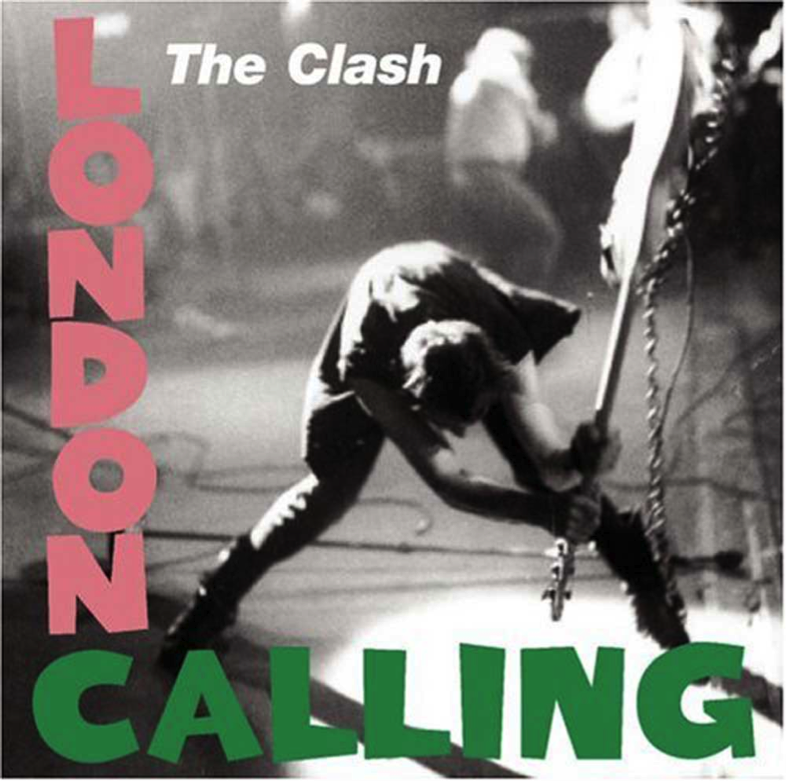
Their third album London calling (CBS, 1977) designed by Ray Lowry, is a homage to Elvis Presley’s debut album and features a photograph of Paul Simonon smashing his bass guitar, shot live at The Palladium in New York by Pennie Smith (figure four). In Coverscaping, Sigrid Lien describes the image ‘it radiates young energy and untamed vitality - ideals that represent the very core of the punk aesthetic’ (2010, p160). Similar live shots of the other band members’ feature on the back cover. In keeping with the Punk aesthetic, Smith prides herself on taking ‘authentic’ portraits of musicians and deliberately uses documentary black and white to strengthen this.
Bragg cites it was The Clash that spurred him to take part in his first act of Political Activism at the Rock against Racism concert in 1977. He went on to front Red Wedge in 1986, a group of musicians using their music as a platform to engage young people with politics. To quote a recent article in The Guardian ‘With love songs and folk anthems and an unshakeable commitment to democratic socialism, Bragg and his guitar have been preaching a modest, very English kind of revolution from stages up and down the land for more than three decades now.’ (2011) Political protest in the form of popular music does not necessarily change the world however in the words of Billy Bragg ‘ it wasn't the Clash that changed my world. It was the audience. In the office I was working in at the time, there was a lot of casual racism. I didn't like it, but I wasn't big enough to say anything. But then I went along to Victoria Park in Hackney one afternoon, and there were 100,000 kids there who felt exactly like me. So I went back to work on Monday morning, and I knew I wasn't alone. My world hadn't changed, but my perception of it had. And that's the role of the musician."
Adorno’s idea that Popular Music is inseparable from consumption takes no account of the critical and discriminating audience or the meanings they can take from the music. Walter Benjamin’s essay ‘The work of art in the age of mechanical reproduction’ offers a much more positive analysis of technological reproduction in culture. ‘The technique of reproduction detaches the reproduced object from the domain of tradition. By making many reproductions it substitutes a plurality of copies for a unique existence. And in permitting the reproduction to meet the beholder or listener in his own particular situation, it reactivates the object produced.’ (Benjamin, 1936, p3)
Benjamin suggests that meaning is produced at the moment of consumption; significance is determined by the process of consumption, regardless of the mode of production. Storey explains this further ‘meaning is no longer seen as unique but open to question, open to use and mobilization’ (2001,p94) Returning to The Clash, the fact they had to ‘sell out’ to CBS in order to distribute their politicised lyrics did not weaken their meaning and significance but armed their global audience with questions and led them to find solidarity with other liberation movement such as the Anti-Nazi League. The Anti-Nazi league together with bands like The Clash and journalists set up ‘Rock against racism’ As Hebdige observed in Hiding in the light ’RAR…was extraordinarily successful in mobilising a popular front to counter the threatened resurgence in the late 1970’s of racist political parties’ (2002, p213)
The interpretation that there is a role for political protest in popular music also brings into question an idea promoted by another Frankfurt School theorist Herbert Marcuse.
‘The idea of art has been turned into a business and all art as gone. As we consume the mass culture ie TV shows and songs this can code us into thinking a certain way about the world in a one dimensional way. Reduces our capacity for free independent thought.’ (Marcuse, 1968, p26-28)
There is no doubt that popular music on many levels is just a business and delivers a form of escapism and one dimensional thinking. Kiss, an American Rock band from the 1970’s are famous for embracing consumer culture, not only selling their music but also licensing a Kiss brand with dolls, comics playing cards and films. Thirty years later, the ‘Kiss Army‘ still travel around the world to see the band at Kiss conventions, shows and trading in merchandise. On another level some popular music can be authentic in expressing and representing the attitudes of a generation and in this way increase their capacity for free independent thought beyond the institutions they have been brought up in. Storey, explains how the Cultural study of Popular culture emerged from the work of The Birmingham School. He describes Hall and Whannel ‘The main thesis of the Popular Arts is that in terms of actual quality…’the struggle between what is good and worthwhile and what is shoddy and debased is not a struggle against the modern forms of communication but a conflict within these media.’ (2001, p51) He goes on to explain how they take the idea that our mass media is pre-digested from Greenberg (who took it from Adorno) and use this to discriminate between good and bad popular culture. They define good popular culture as being able to re-establish the rapport between the performer and audience that was lost with industrialisation. On this basis, the use of political protest within popular music can also be differentiated from the mass; Joan Baez and The Clash were able to re-establish the rapport with their audiences that led to active production of culture rather than its passive consumption.
Although Adorno defined his ‘Culture Industry’ and wrote his critical analysis of popular music around seventy years ago it was obvious from the views expressed in the interview that his ideas had not changed towards the end of his life. This was despite the huge cultural changes that were occurring in part because of music with the advent of Rock and Roll since the fifties. So it makes for a paradoxical conclusion, that with the benefit of historical context, political protest brought together with popular music can be differentiated from mass culture and the ‘warencharakter’ using The Frankfurt School own set of rules; its real and multi-dimensional and promotes active consumption, individual creation and imagination. (Storey 2001, p 93)
Notes from Coverscaping - Discovering Album Aesthetics probably one of the first Academic collection of essays written about Album Covers semiotics and poetics. Considers Album Covers are a visual genre in their own right.
Functions of an album cover
1.Inescapably ' product of the record companies desire to promote their music' p10 2.Conveying the identity of the artist 3.Distilling the aesthetic reality of a specific cultural moment 4. Discusses Genette's literary concept 'paratext'
Genette defines paratext as those things in a published work that accompany the text, things such as the author's name, the title, preface or introduction, or illustrations. Genette states "More than a boundary or a sealed border, the paratext is, rather, a threshold." It is "a zone between text and off-text, a zone not only of transition but also of transaction: a privileged place of pragmatics and a strategy, of an influence on the public, an influence that ... is at the service of a better reception for the text and a more pertinent reading of it". Then quoting Philippe Lejeune, Genette further describes paratext as "a fringe of the printed text which in reality controls one's whole reading of the text". 5 Ekphrasis has been considered generally to be a rhetorical device in which one medium of art tries to relate to another medium by defining and describing its essence and form, and in doing so, relate more directly to the audience, through its illuminative liveliness
6 Greendale by Neil Young is discussed by Nicole Brown in context of Lunenfield's utopian idea of the gesamtkunstwerk or "total work of art," a term traditionally applied to opera's melding of music, lyrics, acting, and stagecraft to create an enhanced vision of creation, reception, and meaning. 7. Galperin suggests the digitalization of music has meant that the power over the music and image is increasedingly reallocated from the media corps to the performers,artists and their audiences. 8. Considering born in the USA by Bruce Spingsteen, Sheehy presents arguments for the importance of rock and roll to our understanding of our broader visual culture and in this case , our political culture as well. P24 9. Context of music and imagery in Politics can be demonstrated by te fact although Born in the USA was released in 1984 an election year the US flag on the album cover was coincidental...Politicians and pundits appropriated Springsteen and his us imagery. The Reagan campaign invited Springsteen to join Reagan at a Campaign. To which Springsteen replied 'I dont think the President listened to my Nebraska album'p27 10. The song Born in the USA 'Spingteen did not intend the song as an anthem of unexamined patriotism but as a critique of the nation's treatment of Vietnam vets. 11. Nicola R Brown 'Album covers are historical artifacts: the images and titles sponsored by artists simultaneously document and create social and historical contexts' ps 43 12.Greendale by Neil Young is discussed in terms of how it represents the visual genres of albums shifting alongside access to new technologies/media.P55 Link to the Greendale website 13. Anne Galperin
The Work Of Art In The Age Of Mechanical Reproduction’ 1936
‘One might generalise by saying: the technique of reproduction detaches the reproduced object from the domain of tradition. By making many reproductions it substitutes a plurality of copies for a unique existence. And in permitting the reproduction to meet the beholder or listener in his own situation, it reactivates the objects produced. These two processes lead to a tremendous shattering of tradition… Their most powerful agent is film. Its social significance, particularly in its most positive form, is inconceivable without its destructive, cathartic aspect, that is, the liquidation of the traditional value of the cultural heritage’
Just pondering about the download generation who say for example download one track from Super black market clash. Would they get the true context and meaning of that track just by listening to the music? Do you need the Album cover to understand the context it was written in ie A photo of Don Letts and the Brixton riots. So in fact the technique of reproduction of music downloading has actually by allowing people to download music in their own homes has detached the real meaning and social significance of the music.'
Adorno speaking about Joan Baez song 'I believe, in fact, that attempts to bring political protest together with ‘popular music’ – that is, with entertainment music – are for the following reason doomed from the start.
The entire sphere of popular music, even there where it dresses itself up in modernist guise is to such a degree inseparable from the Warencharakter(A commodity character) from consumption, from the cross-eyed transfixion with amusement, that –er-attempt to outfit it with a new function remain superficial
And I have to say that when somebody sets himself up, and for whatever reason (accompanies0 maudlin music by singing something or other about Vietnam being unbearable….I find, in fact, THIS SONG unbearable, in that by taking the horrendous and making it somehow consumable, it ends up wringing something like consumption-qualities out of it.
My take: Joan Baez- I think her live long devotion to using her music as a form of education and protest to create social change is a testament to the fact she was not trying to use the 'Vietnam war' for her own gain. She certainly was not trying to reduce something horrnedous into a Consumable. AT the time of the interview possibly '67 maybe this was how she was viewed by some?
'Cartoonist Al Capp, creator of the comic strip Li'l Abner, during the 1960s satirized Baez as "Joanie Phoanie". Joanie was an unabashed communist radical who sang songs of class warfare while hypocritically traveling in a limousine and charging outrageous performance fees to impoverished orphans. Capp had this character singing bizarre songs such as "A Tale of Bagels and Bacon" and "Molotov Cocktails for Two". Although Baez was upset by the parody in 1966, she admits to being more amused in recent years. "I wish I could have laughed at this at the time", she wrote in a caption under one of the strips, reprinted in her autobiography. "Mr. Capp confused me considerably. I'm sorry he's not alive to read this, it would make him chuckle" Capp stated at the time, ""Joanie Phoanie is a repulsive, egomaniacal, un-American, non-taxpaying horror, I see no resemblance to Joan Baez whatsoever, but if Miss Baez wants to prove it, let her."
In 1973 she released 'Where are you now, my son?'which featured a 23-minute title song which took up all of the B-side of the album. Half spoken word poem and half tape-recorded sounds, the song documented Baez's visit to Hanoi, North Vietnam, in December 1972, during which she and her traveling companions survived the 11-day long Christmas Bombings campaign over Hanoi and Haiphong.
However only in the context of her life since the 70's can one perhaps view her sincerity and values for what they obviously are?
Comments off YouTube:
'I tend to like adorno but his views on music and society where too all-encompassing. He was right about consumerism in cultural structures but he didn't realize that even popular music could be subversive to a degree because consumption is only a tool of the state apparatus, not its aim.'
'Mainstream songs should not be used by you during the act of protest.
Buying such songs only fuels the capitalistic system that you detest.
Adorno was talking about how corporations use culture to gain capital as a means to gain power over people. As such, he thought it was counteractive for people to buy music and use it during the act of protest since they would be fueling the very system they were seeking to disband.'
I think that "popular music" has expanded to the point where some of it has actually left the popular music arena. Some of what was "popular music" has become "authentic" as Heidegger would put it. The vast majority of it does fit Adorno's description though.
'Adorno's saying a little more than "they control us through culture".
You need to understand the difference between a mythical symbol and an abstraction, and its relatation to utilitarianism and the reduction of people to numbers.
You gotta think about existentialist views of freedom and the limiting factor of style in the art work.
You need to think how science has become an inversion of myth, and how extreme positivism has limited our ability to constantly reinterpret the inanimate world.'
'Good points, but maybe Dylan (and popuplar music) didn't satisfy Adorno's other criteria you mentioned: an image of a better world. Or as Marx said:..not to interpret the world but to change it.' mrfreudable 7 months ago 'I totally disagree with Adorno here. And I feel that he is in disagreement with himself. Aesthetics: art, music etc. in the Frankfurt School, as I understand, has two functions. Firstly, it is a way accuse/confront the existing social framework. Secondly, it should link us up to an image of a better world beyond the now. The popular folk music in the 60's ( esp. Dylan) is much more powerful than a mere commodity as he explains here. Protest and Freedom are there, intrinsic within the music!'
'By the 70's, it'd've been more clear to him that an entire war had been stopped solely by protests of the citizens, and that music had been an important part of the solidarity and dissemination of the protestors' ideas.
I also wonder if he would have expressed the same feeling about a song like "Strange Fruit," or if he dismissed absolutely all politically-powerful songs as mere "entertainment" if they lacked the forms of classical art music.'
An interesting article about Marx, music and politics On New Music Box The song that is playing on the video and which I assume Adorno is referring is Oh, Freedom which is in fact a Civil War African American song. She actually had been performing that song since 1963 when she sand it at The March on Washington:
Oh Freedom” by Lucy Kinchen
Chorale
Oh freedom, oh freedom, oh freedom over me
And before I'd be a slave I'll be buried in my grave
And go home to my Lord and be free
No more moaning, no more moaning, no more moaning over me
And before I'd be a slave I'll be buried in my grave
And go home to my Lord and be free
No more crying, no more crying, no more crying over me
And before I'd be a slave I'll be buried in my grave
And go home to my Lord and be free
Oh freedom, oh freedom, oh freedom over me
And before I'd be a slave I'll be buried in my grave
And go home to my Lord and be free
There'll be singin', there'll be singin', there'll be singin' over me
And before I'd be a slave I'll be buried in my grave
And go home to my Lord and be free
There'll be glory, there'll be glory, there'll glory over me
And before I'd be a slave I'll be buried in my grave
And go home to my Lord and be free
Oh freedom, oh freedom, oh freedom over me
And before I'd be a slave I'll be buried in my grave
On the whole her Album artwork has not been expressive of her political activism apart from 1971 'Blessed are' and 1972 Come from the shadows' The cover photo features an elderly couple being arrested at an anti-war protest, holding hands and flashing peace signs as they are led away.. From the album's liner notes:
"...In 1972 if you don't fight against a rotten thing you become a part of it" - Joan Baez
'The image of the protest singer has always been seductive - but the notion that you can change the world by singing songs can only serve to undermine activism. Sure, we songwriters have a role to play - we can bring people together to express solidarity, we can help to raise funds, we can use our platform to offer different perspectives - but once we step down from the stage, we are individuals with nothing more than the brittle power that celebrity bestows. My experience tells me that real change can only be achieved by organised individuals working together with one another in common cause.
People tell me that they are inspired by my songs, and for that I’m thankful, but I take my inspiration from the only people in this equation who can actually make a difference - the audience. After 25 years of activism, my faith in your ability to change the world is undimmed.'
mainsteam music today is so removed from most everyday life that anyone with anything real to say is gonna b lost in an ocean of bullshit,punk in the 7o,s had a gravitas n relevence unique to its period of history,todays punks will never experience top of the pops with access to peak viewing by most of the nation,more likely to b sidelined to late night corporate sponsered indie land,or worse the jools holland show,packaged n processed into little genres,fragmented n diffussed their is no buzz of something big going on,no surprises in the mix,.i,m not lamenting the end of totpops,just stating the obvious that a multi media like we got today has fragmented n lost its collective audience,rebel music whatever style or form it takes old or new is never gonna b like the late 70,s,but maybe playing your song at your local pub or open mic is the new frontline,maybe thats where our message is best heard n understood,too quote mr dylan,bringing it all back home,thats where i think it matters,so mr bragg if u ever feel inspired too sing one of your songs too unsuspecting n new audience you more then welcome too come down too our local open mic,certainly cause a buzz round this town
Part of the problem might be that we have a very fixed notion of what exactly “poltical music” is. We immediately think of the classic “protest singers” of the 1960s (Bob Dylan, Phil Ochs… who else?) and often consider the very act of singing a protest or topical song part of a bygone era. But in the art of songwriting both than and now, there’s only a fine line separating personal and political expression. To focus on Dylan, I really doubt anyone will ever pin him down on whether he expected his songs to galvanize public opinion the way they did, or whether he was just expressing how he felt perosnally about what he saw and heard going on around him. Of course he wanted his songs to be heard, but were they intended as a political ideology or personal expression, and does it really matter? (And don’t forget that almost as soon as the media began referring to Dylan as the “voice of a generation”, he very quickly began subverting that image as well as coming out with new songs that were less obviously “political”.) I suggest to the songwriters of today and the potential songwriters of tomorrow that maybe it’s just a matter of singing honestly about your own life and your own views – it may be more of a poltical act than you think. At the same time, if you want to consciously focus on events, politics, and/or social issues, that’s all part of the human experience and therefore fair game for writing songs about. Songs DO have the power to change people’s minds. I’m reminded of what Robert Kennedy said in South Africa in 1966 about how every act in the name of something you beleive in sends out a ripple of hope.
Fold is a socially conscious music project. The main goal is to effect positive change through raising awareness of global issues and contributing funds towards charitable work that aims to redress the imbalance of wealth and resources in the world.
The music aims to reflect as honestly and directly and possible some of the more crucial issues of our time. This reflection is my own interpretation and emotional response to the world around me.
I found this Moving Image whilst researching animation for Top 10 Graphic Designers. Protest songs. This ties in with an essay idea which is emerging, that Music and Graphics can promote meaning in Culture in a way some Theorists promote only high Culture can.
Bille Holiday's Strange Fruit (1939), Buffalo Springfield's For What Its Worth (1968) and Radiohead's Ideoteque (2000).
On this basis, argue against this point maybe?
The idea of art as been turned into a business and all art as gone. As we consume the mass culture ie TV shows and songs this can code us into thinking a certain way about the world in a one dimensional way. Reduces our capacity for free independent thought.
Frankfurt School : Herbert Marcuse
I found this article well into writing my essay whereby the author had made the same links as me between Billy Bragg and the Adorno quote. However its interesting to understand a more academic reading of this conundrum.