I found these on a skateboarding forum some journals worth exploring:
Davidson, J (1985) "Sport and Modern Technology. The Rise of Skateboarding, 1963-1978",
Journal of Popular Culture, 18 (4), pp145-157.
Beal, B (1995)
"Disqualifying the Official: An Exploration of Social Resistance Through the Subculture of Skateboarding", Sociology of Sport Journal, 12, pp252-267.
Beal, B (1996) "
Alternative Masculinity and Its Effects on Gender Relations in the Subculture of Skateboarding",
The Journal of Sport Behavior, 19 (3), pp205-216.
Karsten, L & Pel, E (2000)
"Skateboarders exploring urban public space: Ollies, obstacles and conflicts",
Journal of Housing and the Built Environment, 15 (4), pp327-340. srum Skille, E, (2005) "Individuality or Cultural Reproduction?
Adolescent sport Participation in Norway: Alternative versus Conventional Sports", International Review for the Sociology of Sport, 40 (3), pp307-320.
Borden, I (2001), Skateboarding, Space and the City: Architecture and the Body, Berg.

Contextual Studies
Thursday, 1 November 2012

Dogtown & the Z-boys documentary
An Article in Skateboarder about the Dogtowners from April 2001
The dudes
Tony "Mad Dog" Alva, Jay Adams, Shogo Kubo, Bob Biniak, Jim "Red Dog" Muir, Wentzle Ruml IV, Paul Constantineau, Wes "Bull Dog" Humpston, Arthur Lake, Stacy Peralta, "Baby" Paul Cullen, Marty Grimes, John Palfreyman, Nathan Pratt, Allen Sarlo, Chris Cahill, Skip Engblom, Jeff Ho, C.R. Stecyk III, Billy Yuron, Dexter Greene, Steven Piccolo, Chris Dawson, Jose Gallon, Gary Rosa, The Kaisers, Ray Flores and Glen E. Friedman.
Founding fathers
Skip Engblom, Jeff Ho, and Craig Stecyk are the ones who popularized it, they ran the Zephyr Surf Shop. But Tony Alva and Jay Adams were the most prominent skaters.
How somebody got down
It was a matter of being at the right spots at the right times and people either thought you were cool or they didn't. Had to have style. Hang out at the Zephyr shop. Mode of operation Search and destroy. Enemies The police and the kooks who were getting all the coverage in the magazines down south, but it was more media hype. Base of operation West L.A., Venice and Santa Monica
Soundtrack Ted Nugent, Hendrix, Aerosmith and Led Zep.
Timeline "75 to '79 were the peak years
Memorable moment
Hanging at the DogBowl was the perfect scan-a pool that you were allowed to skate in Northern Santa Monica, a rich neighborhood. Someone from the crew worked it out so they could skate. Totally tight, and no one could get in unless you were part of the crew. Other than that, they were used to being chased out by disgruntled property owners, with chainsaws, baseball bats and shotguns. Influence on skateboarding They were the first ones to go looking over the fences. Skateboarding would have become little league baseball without them. The first ones to get radical and terrorize-the idea of people seeing skateboarders rolling down the street and thinking they are rowdy, and no longer grouping them with bicycle riders, exists because of DogTown. Before them it wasn't looking to go in that direction. DogTown was like Hell's Angel's for people who were too young to ride motorcycles. Now everyone knows that if you have an empty pool in your backyard people will want to skate it, but back in '76 that was inconceivable. They would break into houses, skate their pool, steal their stereo, smoke some dust and leave. Brought the outlaw aspect to skateboarding. First rebel image that the industry failed to control. Also a multicultural group of people before that was a cool thing in other sports, there were Mexicans, Asians, blacks, Jews and whites all mixed together. A documentary chronicling the DogTowners is premiering at the Sundance Film Festival this year. They also invented Frontside airs and handplants.
Narrated by Sean Penn
67/72 Dogtown was Santa Monica down to Venice beach and was a seriously run down surfer area.
Venice of America was founded by tobacco millionaire Abbot Kinney in 1905 as a beach resort town, 14 miles (23 km) west of Los Angeles. He and his partner Francis Ryan had bought two miles (3.24 km) of oceanfront property south of Santa Monica in 1891. They built a resort town on the north end of the property called Ocean Park, which was soon annexed to Santa Monica. After Ryan died, Kinney and his new partners continued building south of Navy Street in the unincorporated territory. After the partnership dissolved in 1904, Kinney built on the marshy land on the south end of the property, intending to create a seaside resort like its namesake in Italy
Over time the area became difficult to manage and in 1929 the area was taken over by LA. By the 50's though it had been so neglected that the area became know as the slum by the sea. It did become home to a vibrant creative community of artists, poets and writers which were to become know as the Beat Generation. In 1958 CBS built the POP, Pacific Ocean Park an amusement and pleasure pier which after two seasons changed hands then started to deteriate until 1974 when it was de,olsided. This was the playground of the Z-boys.
The original Z-boys surfing and skateboarding shop was and is still on Main St. in Santa Monica.
After the sixties surfing was perceived as anti social and just good for drop outs. Surfers in this area were infamous for their agressive localisim and outcast behaviour. In 1972 Skip, Jeff and Stacey opened the Jeff Ho and Zephyr Surfboard productions shop to promote revolutionary Specialist design and avoid the mass media. Proud to be anti-mainstream. Unique identity. Pushed the boundaries of conventional skateboard design.
Craig Stecyk 'It was personalised stuff for the user to make something that wasnt a mass media garbage piece of junk that was designed in a factory for everybody else.'


http://www.crackle.com/c/Dogtown_and_Z-Boys/Dogtown_and_Z_Boys/2478397
http://www.pps.org/great_public_spaces/one?public_place_id=471
The dudes
Tony "Mad Dog" Alva, Jay Adams, Shogo Kubo, Bob Biniak, Jim "Red Dog" Muir, Wentzle Ruml IV, Paul Constantineau, Wes "Bull Dog" Humpston, Arthur Lake, Stacy Peralta, "Baby" Paul Cullen, Marty Grimes, John Palfreyman, Nathan Pratt, Allen Sarlo, Chris Cahill, Skip Engblom, Jeff Ho, C.R. Stecyk III, Billy Yuron, Dexter Greene, Steven Piccolo, Chris Dawson, Jose Gallon, Gary Rosa, The Kaisers, Ray Flores and Glen E. Friedman.
Founding fathers
Skip Engblom, Jeff Ho, and Craig Stecyk are the ones who popularized it, they ran the Zephyr Surf Shop. But Tony Alva and Jay Adams were the most prominent skaters.
How somebody got down
It was a matter of being at the right spots at the right times and people either thought you were cool or they didn't. Had to have style. Hang out at the Zephyr shop. Mode of operation Search and destroy. Enemies The police and the kooks who were getting all the coverage in the magazines down south, but it was more media hype. Base of operation West L.A., Venice and Santa Monica
Soundtrack Ted Nugent, Hendrix, Aerosmith and Led Zep.
Timeline "75 to '79 were the peak years
Memorable moment
Hanging at the DogBowl was the perfect scan-a pool that you were allowed to skate in Northern Santa Monica, a rich neighborhood. Someone from the crew worked it out so they could skate. Totally tight, and no one could get in unless you were part of the crew. Other than that, they were used to being chased out by disgruntled property owners, with chainsaws, baseball bats and shotguns. Influence on skateboarding They were the first ones to go looking over the fences. Skateboarding would have become little league baseball without them. The first ones to get radical and terrorize-the idea of people seeing skateboarders rolling down the street and thinking they are rowdy, and no longer grouping them with bicycle riders, exists because of DogTown. Before them it wasn't looking to go in that direction. DogTown was like Hell's Angel's for people who were too young to ride motorcycles. Now everyone knows that if you have an empty pool in your backyard people will want to skate it, but back in '76 that was inconceivable. They would break into houses, skate their pool, steal their stereo, smoke some dust and leave. Brought the outlaw aspect to skateboarding. First rebel image that the industry failed to control. Also a multicultural group of people before that was a cool thing in other sports, there were Mexicans, Asians, blacks, Jews and whites all mixed together. A documentary chronicling the DogTowners is premiering at the Sundance Film Festival this year. They also invented Frontside airs and handplants.
Narrated by Sean Penn
67/72 Dogtown was Santa Monica down to Venice beach and was a seriously run down surfer area.
Venice of America was founded by tobacco millionaire Abbot Kinney in 1905 as a beach resort town, 14 miles (23 km) west of Los Angeles. He and his partner Francis Ryan had bought two miles (3.24 km) of oceanfront property south of Santa Monica in 1891. They built a resort town on the north end of the property called Ocean Park, which was soon annexed to Santa Monica. After Ryan died, Kinney and his new partners continued building south of Navy Street in the unincorporated territory. After the partnership dissolved in 1904, Kinney built on the marshy land on the south end of the property, intending to create a seaside resort like its namesake in Italy
Over time the area became difficult to manage and in 1929 the area was taken over by LA. By the 50's though it had been so neglected that the area became know as the slum by the sea. It did become home to a vibrant creative community of artists, poets and writers which were to become know as the Beat Generation. In 1958 CBS built the POP, Pacific Ocean Park an amusement and pleasure pier which after two seasons changed hands then started to deteriate until 1974 when it was de,olsided. This was the playground of the Z-boys.
The original Z-boys surfing and skateboarding shop was and is still on Main St. in Santa Monica.
After the sixties surfing was perceived as anti social and just good for drop outs. Surfers in this area were infamous for their agressive localisim and outcast behaviour. In 1972 Skip, Jeff and Stacey opened the Jeff Ho and Zephyr Surfboard productions shop to promote revolutionary Specialist design and avoid the mass media. Proud to be anti-mainstream. Unique identity. Pushed the boundaries of conventional skateboard design.
Craig Stecyk 'It was personalised stuff for the user to make something that wasnt a mass media garbage piece of junk that was designed in a factory for everybody else.'


A dead wonderland
The cove was a secret surfing spot which was very dangerous due to the pier and pylons falling down into the sea. It was a local spot where no visitors were allowed.
Skip and Jeff initially set up the Zephyr surf team. the kids used to hang around the store and work. They were mainy from broken homes and the store became a place to go like a club house.
Brief history of skateboarding
50's The after surfing activity. Make your own from a board and roller skates
1963 An alternative sport which started to reach national popularity
1965 The sport crashed in wave a bad publicity and was subsequently viewed a a kiddie fad until the mid 70's.
Revolution in 1972 in technology the clay wheels were replaced by Polyurethane wheels, Cadillac Wheels. they initially sold the wheels to surf shops in California.
More to Follow..
http://www.crackle.com/c/Dogtown_and_Z-Boys/Dogtown_and_Z_Boys/2478397
http://www.pps.org/great_public_spaces/one?public_place_id=471
Wednesday, 31 October 2012
Primary research - Contacting the Zephyr Team
I wanted to know what the real trigger for the Skateboarders, specifically the Zephyr team for wearing Vans. The First NSA competition for a number of years took place in 1975 and the Zephyr Team turned out in a uniform of Levis, Navy Vans and Zephyr tshirts however this was an orchestrated uniform planned by their management.
I have emailed/tweeted/facebook messaged as many of the Zephyr team as I can find contact details for. So far I have had a response from Skip Engblom who was the co owner of the Zephyr surf shop along with Craig Stycek and Jeff Ho.
This is what I sent and the reply I received:
From: lwdesign
To: skip@smaskateboards.com
Sent: Wednesday, October 31, 2012 4:03 AM
Subject: Vans footwear and The Zephyr team
Hi Skip
I hope you don't mind me contacting you on this email. I would appreciate your input as primary research for my dissertation. I am a mature student studying Graphic Design at Leeds College of Art in the UK.
I am undertaking a critical analysis of Vans the brand from its authentic roots in the USA in 1966 through their association with the subcultural Zephyr skateboarders to mass consumption in the late seventies/ early eighties. Right though to the hyperreal world it now occupies; made in Vietnam but appealing to today's youth culture through its California/surfer/skater roots.
I have watched the Dogtown and Z-boys documentary and also read Skateboarding, Space and the City by Iain Borden. I have also read various interviews in Skateboarder and on Juice.
The reason for contacting you is although I know the Zephyr team started wearing a uniform of Levis, blue vans and blue t shirts for entering competitions I cant find the real trigger for Skateboarders wearing Vans or indeed the year it actually started. Was it the association with Surfing/the sea? I have found stuff about their 'usability' ie the waffle grip sole. I also notice the original Vans store is in Anaheim only 40 miles from Venice Beach. Was there some other link? Did you know anyone at Vans, for example before they started paying the team to wear the shoes after Off the Wall? Or was it pure Youth Culture happening in California at the time.... a signifier.
Any facts or ideas which you would like to contribute at this time would be greatly appreciated.
Best regards Lisa Whitaker
From: "Skip Engblom"
To:
"lwdesign"
Date: Oct 31 2012, 03:05 PM
Subject:
Re: Vans footwear and The Zephyr team
They had a small store in Santa Monica and would make you custom shoes.Also they were very cheap to buy
He then followed it up with a second email:
From: "Skip Engblom"
To:
"lwdesign"
Date: Oct 31 2012, 03:22 PM
Subject:
Re: Vans footwear and The Zephyr team
Also Steve Van Dorn worked there part of the time.
Back then there was a lot of places that did custom things Surf trunks were not easy to get before 1967.You went to a place in Feb or March and ordered your trunks and were ready in May or June. If you went to Hawaii you made a stop at Takie in Wakkaii or H.MURIA on the north shore in Santa Monica you went to Roy,s cabana down south you went to Kustom by Katin.It was a different time and when Duke Boyd told some one he was starting a trunk company called hang ten people said it was the lamest name ever
I subsequently found this:
http://www.skateboardermag.com/industry-news/vans-santa-monica-store-reopening/

I have emailed/tweeted/facebook messaged as many of the Zephyr team as I can find contact details for. So far I have had a response from Skip Engblom who was the co owner of the Zephyr surf shop along with Craig Stycek and Jeff Ho.
This is what I sent and the reply I received:
From: lwdesign
Hi Skip
I hope you don't mind me contacting you on this email. I would appreciate your input as primary research for my dissertation. I am a mature student studying Graphic Design at Leeds College of Art in the UK.
I am undertaking a critical analysis of Vans the brand from its authentic roots in the USA in 1966 through their association with the subcultural Zephyr skateboarders to mass consumption in the late seventies/ early eighties. Right though to the hyperreal world it now occupies; made in Vietnam but appealing to today's youth culture through its California/surfer/skater roots.
I have watched the Dogtown and Z-boys documentary and also read Skateboarding, Space and the City by Iain Borden. I have also read various interviews in Skateboarder and on Juice.
The reason for contacting you is although I know the Zephyr team started wearing a uniform of Levis, blue vans and blue t shirts for entering competitions I cant find the real trigger for Skateboarders wearing Vans or indeed the year it actually started. Was it the association with Surfing/the sea? I have found stuff about their 'usability' ie the waffle grip sole. I also notice the original Vans store is in Anaheim only 40 miles from Venice Beach. Was there some other link? Did you know anyone at Vans, for example before they started paying the team to wear the shoes after Off the Wall? Or was it pure Youth Culture happening in California at the time.... a signifier.
Any facts or ideas which you would like to contribute at this time would be greatly appreciated.
Best regards Lisa Whitaker
From: "Skip Engblom"
He then followed it up with a second email:
From: "Skip Engblom"

Wednesday, 17 October 2012
Dissertation tutorial
I discussed what I had discovered about Vans in terms of its history from the 60's to present day. My initial proposal was trying to pin down why young people buy into the brand today.
I think the key points in their history is
60's - 70's A customised brand - Made on your doorstep. Skateboarders started wearing Vans and Vnas customised them in 76 so more hard wearing 'Off the wall'
80' Mass culture through Hollywood movie Fast times - Global brand
90's/ 2000 US American apparel owned, made in Asia, mainly Vietnam. Brand built on USA 66 sufer dude culture. Targeting youth culture.
Chapter structure could be:
1. 60's/70's history of brand and sub cultural theorird- Hebdidge-looking for authentic symbols
2. 80's Identity in mas culture - Adorno - Culture Industry - plugging, psedo-indivdualism, N Klein No Logo. Hebdidge Incorporation - Crtical approach
3. Post modern - Contemorary , identity fluid, neo tribes, Acticely consume to create meaning.
Baudrillard - Building on USA Branding made in Vietnam - Hyperality created by branding?
Actions:
Complete an extended essay plan
Start drafting chapter one
Tuesday, 16 October 2012
Vans in Camden London & online

Selling a lifestyle still Based on the California/surfer dream


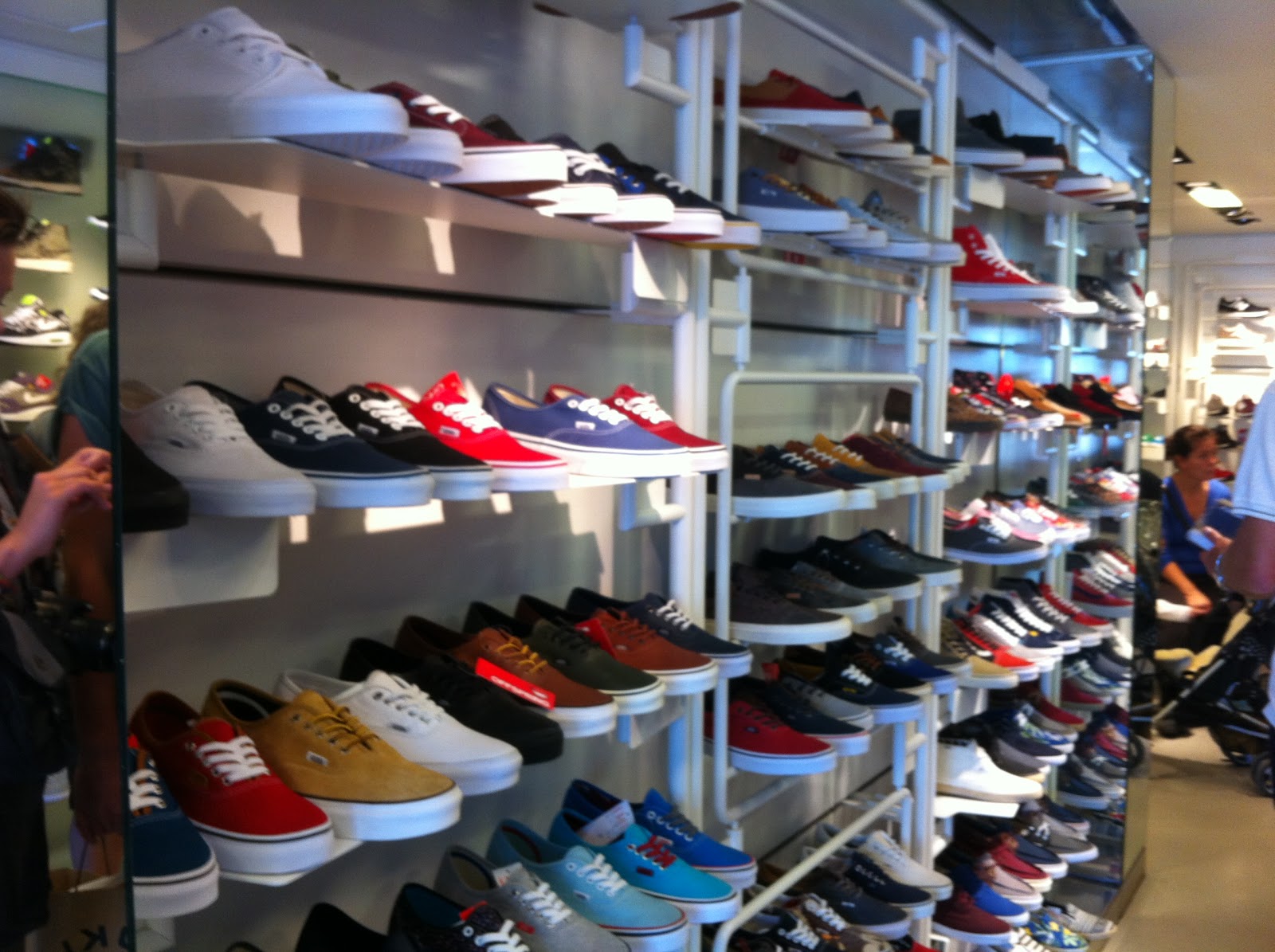
How many different styles of Vans? Not customised but certainly a huge range.
Online there are over 200 styles to chose from including a range called California authentic - although dont think this means they are made in USA just based on the heritage of the brand from 66


Vans & UK music festival
Vans are still very much associated with skatebaording, surfing and music. Testament to this is their sponsorship of various UK music festivals:
NASS (not sponsored by vans in 2012) They did sponsor individual Skaters in the Skater competition
Wakeboarding
The article that said Vans sponsored these events was 2008 since then Vans have introduced their own festival called Vans Warped tour
 Complete with online store

Quite scary when you click on Vans UK and your own son (Oliver) and his friends are all their having liked Vans on Facebook..

NASS (not sponsored by vans in 2012) They did sponsor individual Skaters in the Skater competition
Wakeboarding
The article that said Vans sponsored these events was 2008 since then Vans have introduced their own festival called Vans Warped tour

Quite scary when you click on Vans UK and your own son (Oliver) and his friends are all their having liked Vans on Facebook..

Monday, 15 October 2012
Subscribe to:
Posts (Atom)